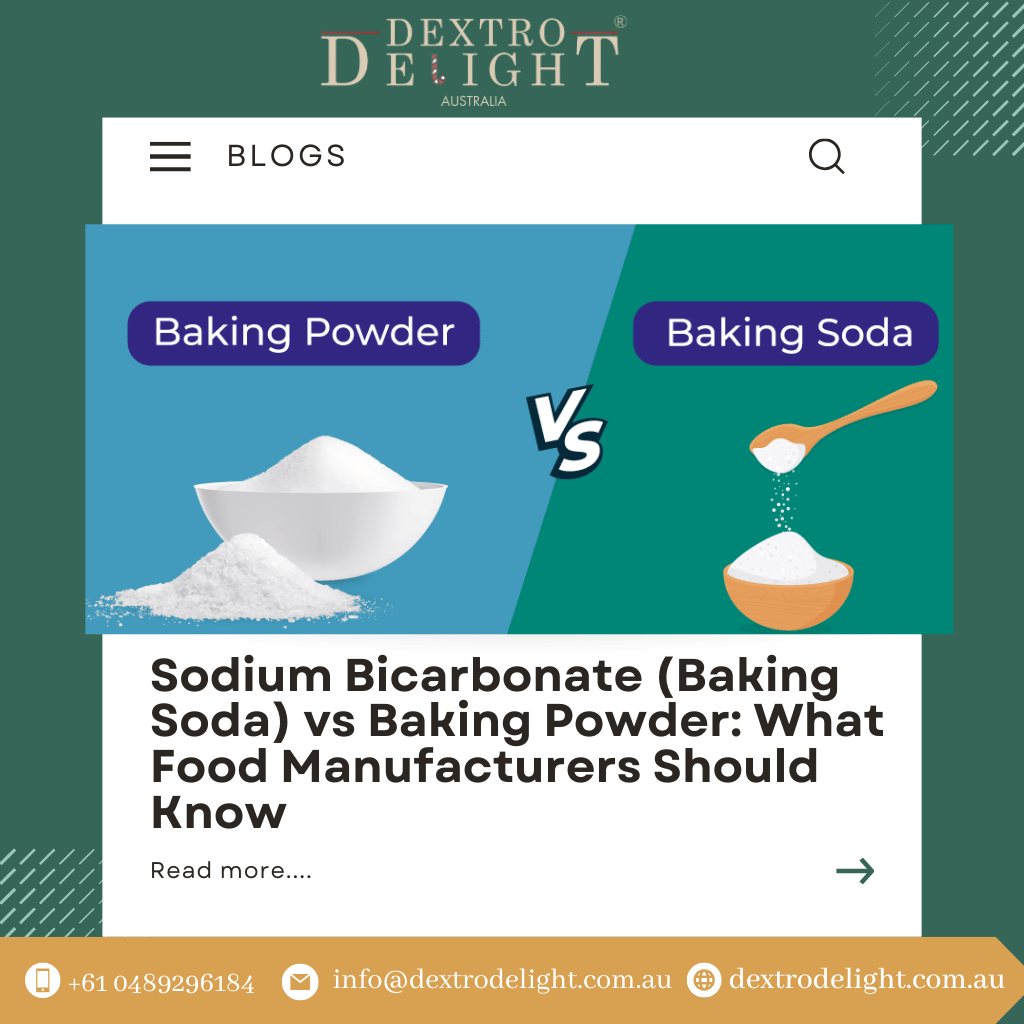
In commercial food production, picking the right leavening agent really shapes your product’s texture, consistency, and efficiency. It all depends on that choice. People often lump sodium bicarbonate (that’s baking soda) and baking powder together, but the truth is, they work in totally different ways. If you want to keep your formulations correct and your product quality solid, you’ve got to understand what sets them apart.
If you’re sourcing from a dependable sodium bicarbonate powder supplier, getting this right matters even more. Formulation accuracy depends on both ingredient quality and correct application
Let’s learn in detail.
The Chemistry Behind Leavening Systems
Both baking soda and baking powder are chemical leavening agents. Their primary role is to release carbon dioxide gas as the dough or batter heats up, which makes everything turn light and airy inside.
Sodium bicarbonate (NaHCO₃) is pretty straightforward; it’s just one compound. To get it working, you need moisture and an acid. Mix it with ingredients like buttermilk, cocoa, or citric acid, and it reacts immediately to release carbon dioxide.
Baking powder is more like a complete system. It has sodium bicarbonate, dry acids (like cream of tartar), and usually some starch to keep it stable. You don’t need an extra acid in your recipe; baking powder does it all. Gas gets generated as soon as there’s moisture and heat, even without any acidic ingredients.
Food Standards Australia New Zealand (FSANZ) gives the green light to both baking soda and baking powder for food use, as long as you stick within their usage limits.
Sodium Bicarbonate: Fast Reaction, High Efficiency
Sodium bicarbonate is known for its quick reaction profile. Once hydrated and exposed to an acid, it starts producing CO2 right away. That’s perfect when you want to keep production moving at high-speed.
In industrial bakeries, you’ll see sodium bicarbonate in:
- Cakes, muffins, quick breads
- Biscuits and cookies
- Gluten-free baked goods
Since the reaction starts immediately, timing becomes crucial. You have to mix and bake without delay if you want your product to rise as intended.
Plus, this substance is strong. Sodium bicarbonate is about three or four times more potent than baking powder. That means you use smaller quantities to get the same effect, which keeps costs down for manufacturers working with large batch volumes.
Baking Powder: Controlled and Dual-Stage Leavening
The gas release from baking powder can be controlled with accuracy. The majority of baking powders that commercial bakeries use operate as double-acting agents because they generate carbon dioxide through two different processes:
- Initial release during mixing (when moisture is added)
- Secondary release during baking (when heat activates the remaining reaction)
The two-step reaction process proves useful for large-scale production operations that experience delays between their mixing and baking processes.
Baking powder is typically used in formulations where:
- No natural acid is present
- A consistent rise is required across varying production conditions
- Longer batter holding times are needed
Functional Impact on Product Quality
Choosing sodium bicarbonate or baking powder directly affects multiple product attributes like
Texture and Structure
Sodium bicarbonate makes things airy and open because it releases carbon dioxide quickly. Baking powder gives you a more uniform and controlled rise.
Flavour Profile
Excess sodium bicarbonate can leave an alkaline, soapy aftertaste if there’s not enough acid to balance it. Meanwhile, baking powder comes with its own acidity, so you’re less likely to run into flavour issues.
Colour Development
Sodium bicarbonate also gives you more browning through the Maillard reaction thanks to its alkaline nature, which can make baked goods look richer. While baking powder tends to result in a lighter colour.
Substitution in Industrial Formulation
You can switch between sodium bicarbonate and baking powder, but it requires careful recalibration.
- If you swap baking powder for sodium bicarbonate, you need to add some acid to keep the reaction balanced.
- If you trade sodium bicarbonate for baking powder, you’ll require three times the quantity to get the same lift.
Get the ratios wrong, and products can turn out flat, taste weird, or have inconsistent textures, and that has an impact on product quality and brand reputation.
Beyond Baking: Additional Roles of Sodium Bicarbonate
Sodium bicarbonate isn’t just for baked goods. Manufacturers use it to control pH in sauces and dairy, tenderise meat, help with carbonation in drinks, and extend shelf life by keeping pH in check.
This multifunctionality makes it a valuable ingredient across a wide range of food products.
Market Relevance and Industry Demand
The global sodium bicarbonate market keeps growing because it’s used in so many industries, such as food, pharmaceuticals and many more. More people are eating baked goods and processed foods, so demand isn’t slowing down.
For Australian manufacturers, working with a reliable Sodium Bicarbonate Powder Supplier ensures reliable performance across production batches.
How to Choose the Right Ingredient for Your Product
Deciding between sodium bicarbonate and baking powder comes down to the recipe and production needs:
Choose sodium bicarbonate when:
- Formulation includes acidic ingredients
- If you need a fast, strong leavening effect
- If you have a restricted budget
Choose baking powder when:
- No acid is present in the formulation
- When you need that controlled, staged leavening
- Production schedules aren’t always predictable.
Knowing these differences helps manufacturers get the best quality and efficiency out of their recipes.
Conclusion
Sodium bicarbonate and baking powder do a similar job, but they work in different ways. For food manufacturers in Australia, understanding when and how to use each can significantly influence product performance, cost management, and consumer satisfaction.
Working with a dependable Baking and Sodium Bicarbonate Powder Supplier guarantees consistency and technical support for your formulation needs.
If you’re still searching for the best food ingredient supplier, Dextro Delight offers top-quality sodium bicarbonate and baking powder that meet your manufacturing demands.
Do you want to fine-tune your recipes and boost your product performance?
Reach out to Dextro Delight today.
Related Posts
Why Soy Lecithin Powder is Becoming a Popular Emulsifier in Clean Label Foods
Most Common Food Thickeners Used in Australian Food Manufacturing