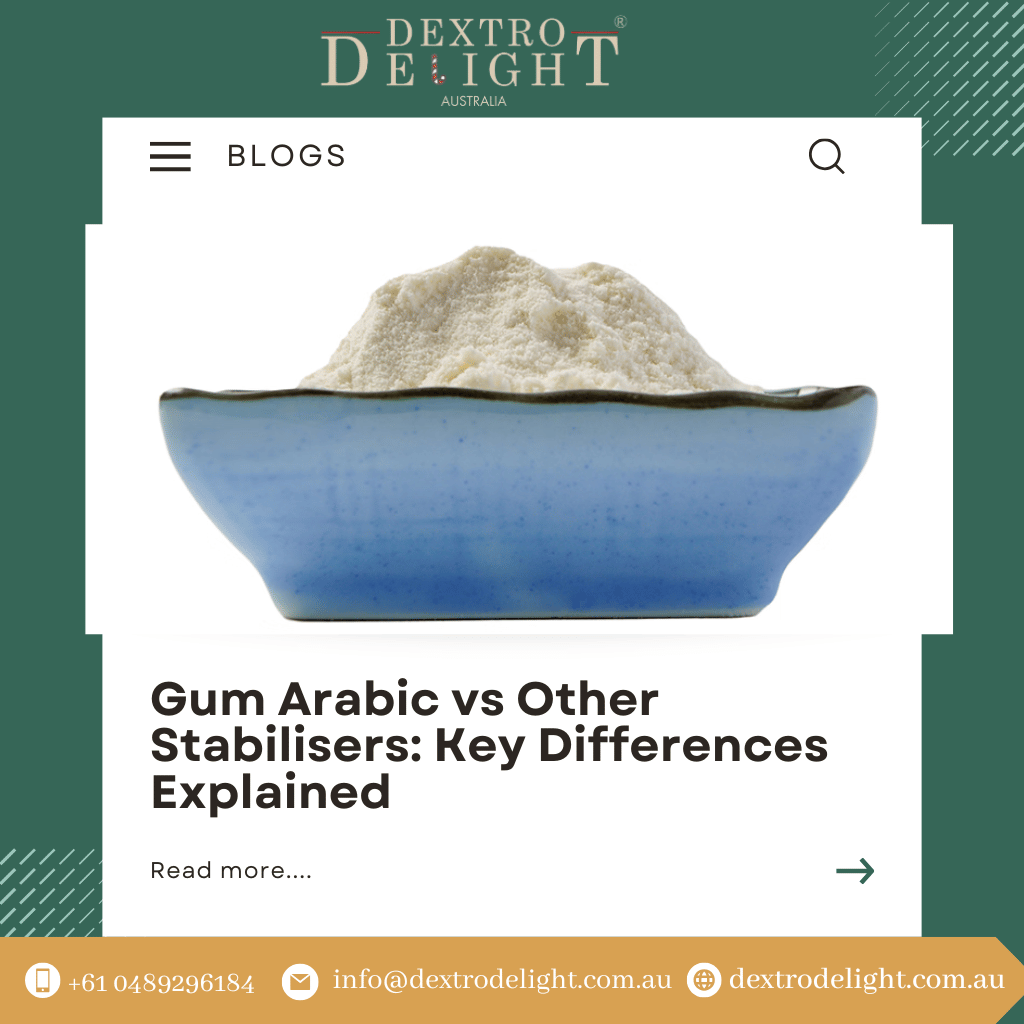
Gum Arabic Australia has emerged as a popular choice among food manufacturers who seek natural stabilisation solutions that maintain constant performance throughout their beverage, confectionery and functional food products.
The increasing demand for plant-based hydrocolloids makes it necessary to evaluate gum arabic performance against other stabilisers like guar gum and xanthan gum for successful product development.
Although these ingredients often serve similar purposes, such as enhancing texture, controlling separation and extending product shelf life, their performance traits show distinct variations.
The selection process for the appropriate stabiliser requires an assessment of viscosity requirements, clarity specifications, processing conditions and financial factors.
Let’s read more.
Understanding Stabiliser Function in Food Systems
Stabilisers function as hydrocolloids that regulate viscosity, emulsification, suspension and water-binding properties. The products show their mouthfeel effects, preventing phase separation and strengthening structural integrity in dairy alternatives, sauces and bakery products.
All Stabilisers used in Australia must meet the standards established by Food Standards Australia New Zealand (FSANZ) regulations for food safety. All three substances, gum arabic (INS 414), guar gum (INS 412), and xanthan gum (INS 415), have received regulatory approval for use within specified limitations.
Although both regulations show similar requirements, their food matrix performance demonstrates significant differences.
Gum Arabic: A Specialist in Clarity and Emulsion Stability
Gum arabic comes from Acacia senegal and Acacia seyal trees. It comes from their tree sap. The chemical composition of the substance contains primarily arabinogalactan polysaccharides, which create its special ability to function as an emulsifier.
Gum arabic produces clear solutions with low viscosity that dissolve in water because of its different properties from high-viscosity gums. The product works best for:
- Soft drinks and flavoured waters
- Almond milk and plant-based beverages
- Spray-dried flavour powders
- Confectionery coatings and glazes
The emulsifying function enables oil droplets to stay suspended in the mixture without synthetic emulsifiers. The process becomes essential for producing flavour emulsions and essential oil dispersions.
The substance offers another benefit because it acts as a soluble dietary fibre. Research published in Nutrients (2023) highlights that gum arabic helps maintain gut microbiota balance when people consume 5 to 10 grams of the substance daily.
For Australian brands targeting functional foods, this dual role ( stabiliser and fibre source )strengthens product positioning.
Guar Gum: High Viscosity at Low Inclusion
Guar gum comes from the extraction process of guar beans (scientifically known as Cyamopsis tetragonoloba ), and these beans grow mainly in Indian and Pakistani regions. The substance is scientifically identified as a Galactomannan which generates three times more viscosity than Gum Arabic.
The practical applications of guar gum:
- Thickens rapidly in cold water
- Forms opaque, gel-like textures
- Enhances body in dairy and bakery applications
The substance has common applications in:
- Ice creams and yoghurts
- Sauces and gravies
- Gluten-free dough systems
Guar gum provides a cost-efficient solution for products that require thickness at minimal use because it enables thickness at very low concentration levels. But, this substance does not provide the transparent appearance or the emulsification capabilities that gum Arabic delivers.
Xanthan Gum: Structural and Suspension Strength
Xanthan gum originates from the fermentation process of Xanthomonas campestris bacteria is used as a stabiliser. The substance generates strong viscosity with excellent suspension stability.
Xanthan gum performs well in:
- Salad dressings
- Sauces requiring shear stability
- Gluten-free baking
Unlike gum Arabic, Xanthan gum produces thicker textures than Gum Arabic, while it also creates elastic networks in dough systems. The substance provides neither the transparent appearance nor the flavour protection that Gum Arabic delivers.
Key Functional Differences at a Glance
|
Property |
Gum Arabic |
Guar Gum |
Xanthan Gum |
|---|---|---|---|
|
Source |
Acacia tree sap |
Guar beans (Cyamopsis tetragonoloba) |
Fermentation of Xanthomonas campestris |
|
Viscosity Level |
Low |
High |
Moderate to High |
|
Solution Appearance |
Clear |
Opaque |
Opaque to slightly cloudy |
|
Emulsification Ability |
Excellent for oil-in-water emulsions |
Limited emulsification |
Good stabilisation, but not a primary emulsifier |
|
Typical Usage Level |
Higher inclusion required |
Very low concentration needed |
Low to moderate concentration |
|
Cost Consideration |
Premium ingredient |
Cost-effective |
Moderate pricing |
|
Best Suited For |
Beverages, flavour emulsions, confectionery coatings |
Dairy, sauces, gluten-free dough |
Dressings, sauces, gluten-free baking |
Gum Arabic Australia provides beverage manufacturers with essential benefits that help them achieve product clarity, suspension stability and emulsification results. The application of Guar Gum as a thickening agent is suitable for creating dense textures such as yoghurts or gravies.
When to Use Gum Arabic Over Other Stabilisers
Choose gum arabic when your formulation requires:
- Oil-in-water emulsion stability
- Transparent or lightly coloured products
- Spray drying and flavour encapsulation
- Fibre enrichment in functional foods
- Reduced sugar or fat formulations requiring viscosity without heaviness
The product works effectively in confectionery applications, preventing sugar crystallisation and enhancing gloss in coated products. Gum Arabic controls water activity in cereal bars and layered snacks, which helps preserve their texture throughout storage while reducing hardness or moisture migration.
Can These Gums Work Together?
Yes. The combination of stabilisers in complex formulations generates synergistic effects. For example, Guar Gum provides body to products while Gum Arabic functions as an emulsification stabiliser.
Food technologists use this method to create precise control over product texture and product shelf stability.
However, synergy requires controlled formulation trials to avoid excessive thickness or instability.
Conclusion
Selecting the right stabiliser depends on your product’s technical specifications. The application of Guar Gum should be used when the production of high viscosity and opaque materials is needed. Xanthan gum provides both suspension strength and gluten-free elastic properties, which make it the ideal choice.
Go for Gum Arabic Australia clarity, emulsification, encapsulation, and fibre functionality are priorities.
Dextro Delight provides Australian food manufacturers with premium Gum Arabic products and various hydrocolloids that serve functional purposes. We are here to provide scientific expertise to assist you with clean-label product development and product improvement needs.
Connect with us and know more about our products.
Related Posts

Qualities That Make a Food Chemicals Supplier Reliable and Industry Trusted
Applications of Gum Arabic in Clean-Label Food Products.