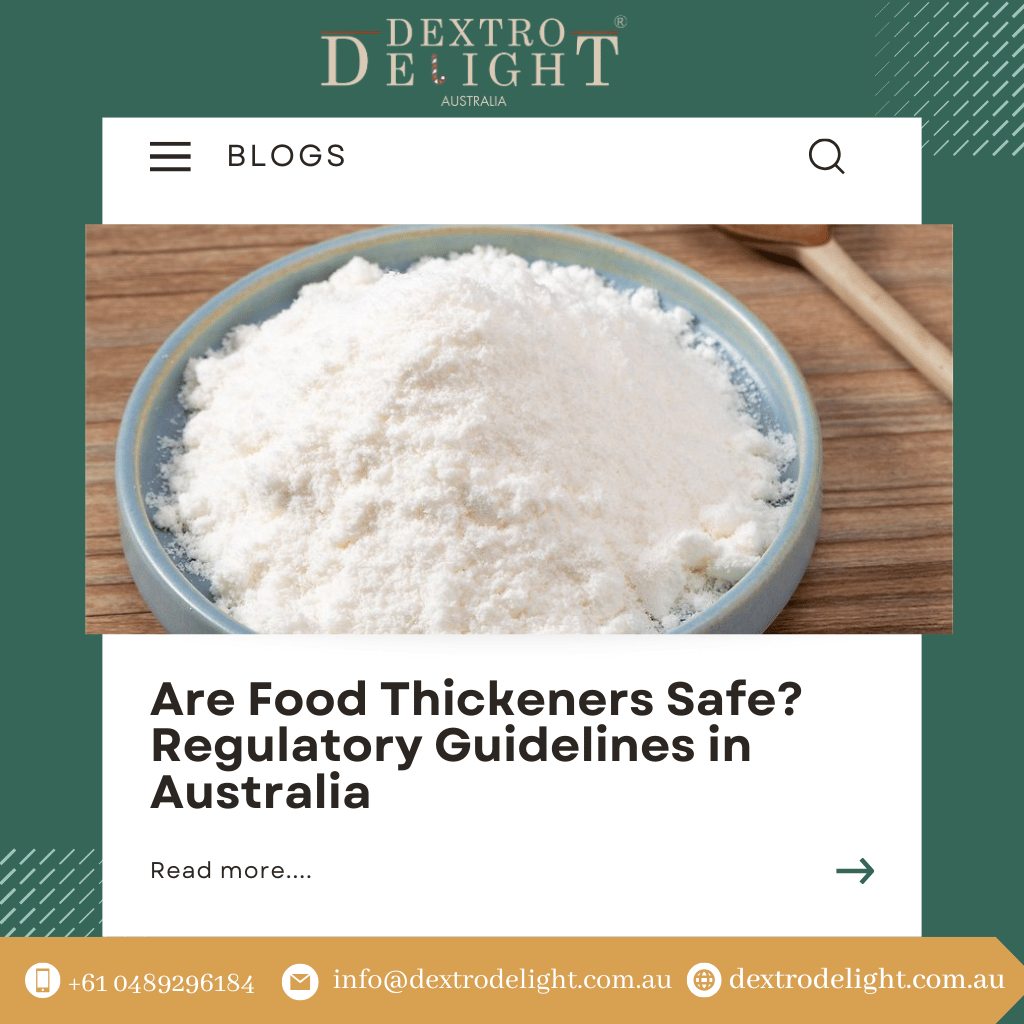
If you’ve ever checked a food label and spotted names like xanthan gum, guar gum or modified starch, you’ve probably wondered — are food thickeners safe?
It’s a fair question. Australians are more label-aware than ever. According to Food Standards Australia New Zealand (FSANZ), over 70% of Australians regularly read food labels before buying packaged food. With growing interest in clean eating and natural ingredients, people want clear answers.
At Dextro Delight, we work closely with food manufacturers across Australia, so let’s break this down properly — what food thickeners are, who regulates them, and whether you really need to worry.
Are Food Thickeners Safe in Australia?
Short answer? Yes — food thickeners approved in Australia are considered safe when used within regulated limits.
Australia has one of the strictest food safety systems in the world. Before any thickener is approved for use, it goes through scientific testing, toxicology assessments and regulatory review.
But let’s look at the details.
What Are Food Thickeners?
Food thickeners are ingredients added to improve texture, consistency and stability.
You’ll find them in:
- Ice cream
- Yoghurt
- Sauces and gravies
- Gluten-free bakery
- Plant-based milk
- Thickened fluids in aged care
They help prevent separation, improve mouthfeel and extend shelf life.
Natural vs Synthetic Thickeners
Most food thickeners Australia uses are plant-based or naturally derived. For example:
- Xanthan gum (fermented sugar)
- Guar gum (from guar beans)
- Pectin (from fruit)
- Agar (from seaweed)
Even “modified starch” isn’t synthetic in a scary way — it’s simply starch altered to perform better in food processing.
Common Food Thickeners Approved in Australia
Under Australian regulations, approved thickeners include:
Plant-Based Thickeners
- Guar Gum (E412)
- Xanthan Gum (E415)
- Locust Bean Gum (E410)
- Carrageenan (E407)
- Pectin (E440)
Starch-Based Thickeners
- Modified starches (E1400–E1450 range)
- Corn starch
- Tapioca starch
Marine & Animal-Based
- Agar (E406)
- Gelatine
These are all legally approved under the Australia New Zealand Food Standards Code.
Who Regulates Food Thickeners in Australia?
Food thickeners Australia wide are regulated by Food Standards Australia New Zealand (FSANZ).
FSANZ:
- Conducts scientific risk assessments
- Reviews toxicology studies
- Sets maximum permitted levels
- Establishes Acceptable Daily Intake (ADI) limits
They operate under Standard 1.3.1 of the Food Standards Code, which strictly controls food additives.
Australia’s food industry is worth over $150 billion annually, so strict compliance is non-negotiable.
State food authorities also monitor compliance, and Australia runs one of the most transparent food recall systems globally.
How Are Food Thickeners Tested for Safety?
Before approval, thickeners undergo:
- Long-term animal studies
- Digestive tolerance testing
- Allergen assessment
- International review comparison (Codex, EU, US FDA)
FSANZ sets an Acceptable Daily Intake (ADI) — the amount considered safe to consume every day for life without health risk.
Importantly, real-world consumption is typically well below ADI levels for most Australians.
Are Food Thickeners Safe for Children & Babies?
This is one of the most searched questions online.
Yes — but within strict limits.
Infant formulas and baby foods in Australia are heavily regulated. Additives permitted for adults are not automatically allowed in infant products.
FSANZ conducts separate safety assessments for children because of their lower body weight and developing systems.
Food Thickeners in Medical Nutrition (NDIS & Aged Care)
In Australia, thickened fluids are widely used for people with dysphagia (swallowing difficulties).
Under NDIS and aged care guidelines:
- Thickened drinks help prevent choking
- They reduce aspiration risk
- They improve hydration safety
Hospitals and aged care homes use regulated products specifically formulated for medical safety.
So yes — thickened fluids are considered safe when professionally prescribed.
Common Consumer Concerns
Do Food Thickeners Cause Gut Issues?
Some people with IBS or sensitive digestion may experience bloating with certain gums. However:
- Most people tolerate approved thickeners well
- Issues are dose-dependent
- Scientific reviews have not classified common thickeners as harmful for the general population
Are Thickeners Linked to Cancer?
There is no strong scientific evidence showing approved food thickeners in Australia cause cancer at regulated levels.
Regulatory authorities continually review emerging data.
What Does “Modified” Really Mean?
Modified starch simply means the starch has been physically or chemically adjusted to improve performance — not that it’s artificial or dangerous.
Understanding Acceptable Daily Intake (ADI)
ADI is calculated using extensive safety margins.
For example:
If a substance shows no harmful effects at a certain dose in studies, regulators apply a safety factor (often 100 times lower) to determine the safe human intake.
That means even regular consumption is considered safe within limits.
Studies show Australians generally consume additive levels far below ADI thresholds.
Natural vs Synthetic: Which Is Safer?
In reality, safety depends on dosage, not whether something is “natural.”
For example:
- Xanthan gum (natural fermentation)
- Modified starch (processed but safe)
Both are approved under Australian law and considered safe when used correctly.
Labelling Rules in Australia
Food labelling laws require:
- Full ingredient disclosure
- E-number or name identification
- Allergen declarations
This transparency allows consumers to make informed choices.
Industry Perspective
From a manufacturer’s point of view, food thickeners Australia uses must meet:
- Strict quality standards
- Batch testing requirements
- Regulatory documentation
At Dextro Delight, we ensure all ingredients meet Australian compliance standards before reaching food producers.
Final Verdict: Should Australians Be Concerned?
For the average healthy Australian, approved food thickeners are safe.
If you have specific sensitivities, medical conditions or dietary concerns, it’s always wise to consult a healthcare professional.
But overall, Australia’s regulatory system is strong, science-based and transparent.
FAQ
Are food thickeners safe in Australia?
Yes. Approved food thickeners Australia uses are considered safe when consumed within regulated limits set by FSANZ.
Are E numbers dangerous?
No. E numbers are simply identification codes for approved food additives.
Is xanthan gum safe to eat daily?
For most people, yes — within normal dietary intake levels.
Are thickeners safe for babies?
Only specific approved thickeners are allowed in infant food, and they are strictly regulated.
Are thickened fluids safe for elderly Australians?
Yes, especially when prescribed for swallowing difficulties under medical guidance.
Related Posts
Common Challenges Food Manufacturers Face with Ingredient Suppliers
Why Soy Lecithin Powder is Becoming a Popular Emulsifier in Clean Label Foods