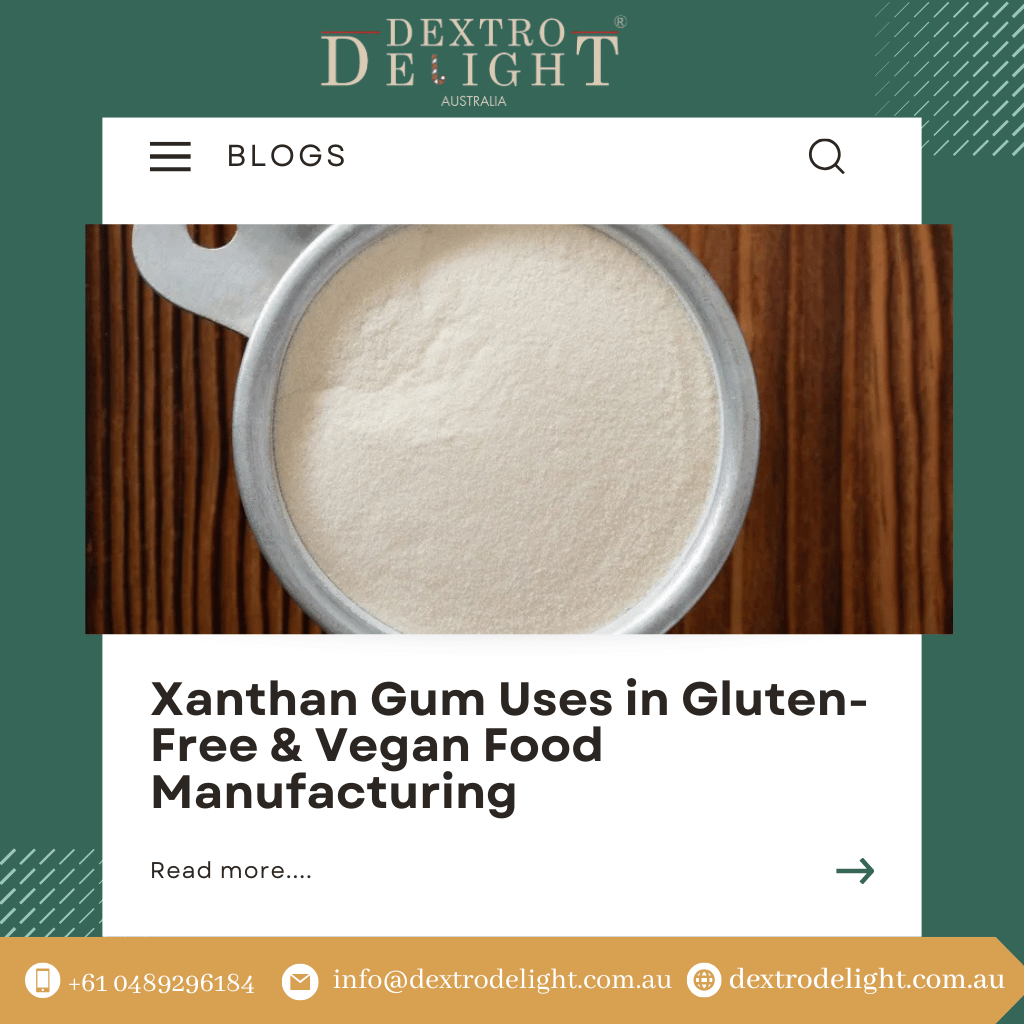
Xanthan gum is one of the most widely used functional ingredients in the gluten-free and vegan food manufacturing industries. Its primary role is simple but vital: it acts as a substitute for the structural and binding properties when gluten and animal-based ingredients are removed.
Xanthan gum Australia has become a solution of choice for commercial bakeries, plant-based food brands, and ready-to-eat manufacturers in terms of quality control, stability, and texture management.
In Australia, where gluten-free and vegan product demand continues to rise, manufacturers rely on best-performing ingredients that produce at a large scale while meeting food safety and labelling standards.
How Xanthan Gum Is Produced (In Simple Terms)
Through fermentation, Xanthan gum is produced. A bacterium that naturally occurs, Xanthomonas campestris, ferments natural and sugar carbohydrates like glucose or sucrose. The resulting polysaccharide is purified, dried, and milled into a fine powder.
For manufacturers, the significance lies in consistency. Fermentation-based production guarantees that xanthan gum gives the same viscosity and binding properties throughout different batches. A primary requirement for large-scale food manufacturing in Australia.
Why Xanthan Gum is Used in Gluten-Free Production
Gluten is responsible for the dough’s properties of elasticity, strength, moisture retention, and flexibility. When wheat is removed, food systems lose their natural binding network. Xanthan gum takes over the loss by producing a viscous gel when hydrated, creating cohesion between starches, proteins, and fats.
Xanthan gum is utilised in gluten-free breads, cakes, and pastries for the following:
- Eliminates crumbling and falling
- Makes the handling of the dough easier in mixing and shaping
- Brings out the crumb structure and elasticity more
- Makes the product last longer by retaining the moisture
Food Standards Australia New Zealand (FSANZ) has approved xanthan gum (INS 415) for use in food manufacturing within regulated limits, making it a compliant and trusted additive for Australian processors.
Functional Benefits in Vegan Food Manufacturing
Vegan formulations face similar challenges to gluten-free products: the loss of eggs, dairy proteins, and gelatin means less structure and less emulsification. Xanthan gum Australia is the one that plays the dual role here. It works as both a binder and a stabiliser at the same time.
In the production of plant-based foods, the enzyme plays an important role in:
- Stability of dairy-free sauces and dressings emulsions
- Thickness of non-dairy plant drinks
- Uniformity of the texture of eggless baked goods
- Stability of vegan desserts during freeze-thaw cycles
As per the market research conducted by Grand View Research in 2024, it was disclosed that the hydrocolloids, including xanthan gum, would still be the mainstay in the plant-based food systems due to their versatile performance and low dosage.
Usage Levels in Commercial Food Manufacturing
Xanthan gum is very efficient even at the minimum levels, which makes it an economical purchase for the manufacturers.
Standard usage rates are:
- Gluten-free bread: 0.3%–0.8% of flour weight
- Cakes and muffins: 0.2%–0.5%
- Vegan sauces and dressings: 0.1%–0.4%
- Plant-based beverages: 0.05%–0.2%
The use of excessive xanthan gum may lead to products with very thick or sticky textures. You need to use a careful formulation, especially in gluten-free baking processes.
Xanthan Gum vs Natural Binders in Manufacturing
Artisan baking can effectively use natural binders like chia, flaxseed, and psyllium, but their large-scale application has the following downsides:
- Hydration is not uniform
- Shelf life is shorter
- Flavour or colour impact is stronger
On the contrary, xanthan gum provides manufacturers with:
- Taste and appearance neutral
- Long shelf life
- Predictability in performance in automated systems
The consistency is the reason Xanthan gum Australia is a major ingredient in the production of gluten-free and vegan foods.
Conclusion
Xanthan gum is an essential component in the manufacturing process of gluten-free and vegan foods. Its striking properties of gluten-like structure imitation, emulsion stabilisation, and shelf life extension are particularly important for Australian food manufacturers whose operations require large quantities.
Dextro Delight is a reliable ingredient supplier for functional food materials that ensure stable production, high-quality products and regulatory compliance. If you are producing gluten-free and vegan products, do not hesitate to contact Dextro Delight.
Related Posts

How Should Chemicals Be Stored in Food Premises to Meet Australian Safety Standards
Applications of Dextrose Monohydrate in Bakery, Dairy & Confectionery