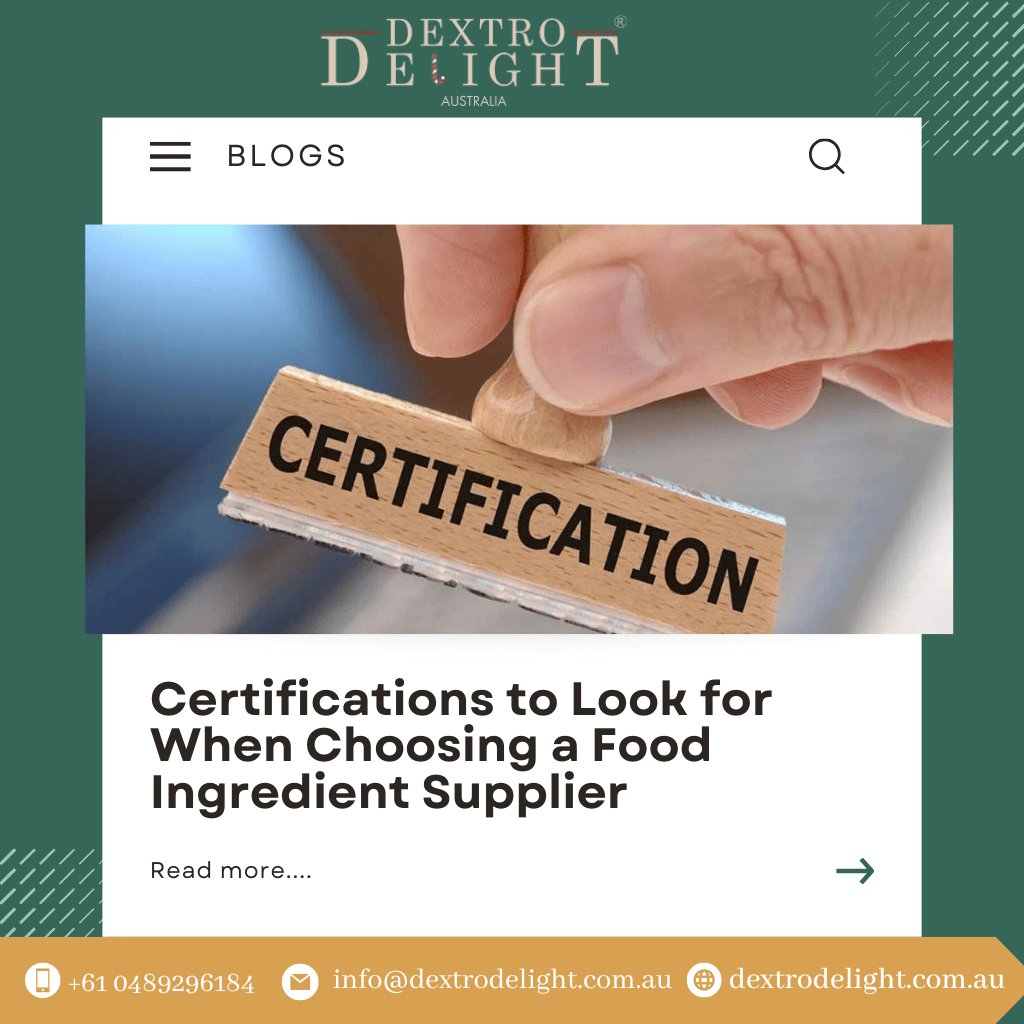
Choosing the right food ingredient supplier isn’t just about price or availability anymore. For Australian food manufacturers, certifications are non-negotiable. They protect your business, your customers, and your brand reputation.
Whether you’re producing bakery items, beverages, snacks, or processed foods, working with leading food ingredient suppliers in Australia who hold the right certifications ensures safety, consistency, and compliance.
At Dextro Delight, we work with food businesses across Australia, and one thing we always emphasise is this:
👉 If your supplier isn’t certified, your business is at risk.
Let’s break down the key certifications you should always check before choosing a food ingredient supplier.
Understanding Food Ingredient Certifications
Food ingredient certifications are formal standards that confirm a supplier follows strict rules for:
- Food safety
- Quality control
- Hygiene and handling
- Traceability and documentation
Some certifications are mandatory under Australian law, while others are industry-expected best practices.
According to Food Standards Australia New Zealand, over 30% of food recalls in Australia are linked to supplier-level compliance failures. Certifications help prevent that.
FSANZ Compliance – The Absolute Basic Requirement
FSANZ (Food Standards Australia New Zealand) compliance is the foundation of food safety in Australia.
A certified supplier must ensure:
- Ingredients are approved for food use
- Additives meet legal limits
- Allergen labelling is accurate
- Products are safe for consumption
Any supplier claiming to be among the leading food ingredient suppliers Australia must clearly demonstrate FSANZ compliance.
💡 Tip: If a supplier can’t clearly explain FSANZ requirements or provide documentation, walk away.
HACCP Certification – Managing Food Safety Risks
HACCP (Hazard Analysis and Critical Control Points) is one of the most important certifications in the food industry.
It ensures the supplier:
- Identifies potential contamination risks
- Controls hazards during sourcing, storage, and distribution
- Maintains documented safety procedures
📊 Industry data shows that HACCP-certified suppliers reduce contamination risks by over 50% compared to non-certified suppliers.
Most serious Australian food manufacturers now only work with HACCP-certified suppliers—and for good reason.
ISO Certifications – Consistency and Quality Control
ISO certifications show that a supplier doesn’t just meet safety standards once—but maintains them consistently.
ISO 22000 – Food Safety Management
Ensures end-to-end food safety systems are in place.
ISO 9001 – Quality Management
Ensures consistent product quality, documentation, and customer satisfaction.
Suppliers with ISO certifications are better equipped to handle:
- Bulk orders
- Long-term supply contracts
- Export-ready compliance
This is a strong marker of leading food ingredient suppliers Australia.
GMP – Good Manufacturing Practices
GMP certification focuses on how ingredients are handled and processed.
It covers:
- Clean production environments
- Proper staff hygiene
- Equipment sanitation
- Accurate record-keeping
For bulk food ingredients, preservatives, sweeteners, and bulking agents, GMP is critical.
Without GMP, ingredient quality can vary from batch to batch—something no manufacturer wants.
Halal and Kosher Certifications
Australia is a multicultural market, and food brands increasingly cater to diverse dietary needs.
Halal and Kosher certifications:
- Expand your product’s market reach
- Increase trust with retailers and export partners
- Show high standards of ingredient sourcing and handling
Even if your product isn’t marketed as Halal or Kosher, sourcing from certified suppliers adds an extra layer of credibility.
Certificate of Analysis (COA) and Technical Documents
A Certificate of Analysis (COA) is just as important as a formal certification.
A proper COA includes:
- Ingredient purity levels
- Moisture content
- Microbiological results
- Batch number and expiry date
Leading suppliers also provide:
- Safety Data Sheets (SDS/MSDS)
- Technical specification sheets
- Storage and usage guidelines
At Dextro Delight, every ingredient comes with full documentation—because transparency builds trust.
Non-GMO, Allergen-Free & Clean Label Declarations
Consumer demand is shifting fast.
📈 According to Nielsen Australia, 73% of consumers prefer brands with clear ingredient transparency.
Certifications and declarations for:
- Non-GMO
- Allergen-free handling
- Clean-label formulations
help manufacturers meet retail and consumer expectations—especially in bakery, beverage, and snack segments.
Import & Export Certifications (If Applicable)
If your supplier imports ingredients, they should manage:
- AQIS import approvals
- Customs documentation
- Country-of-origin traceability
Reliable suppliers take responsibility for compliance—so you don’t get stuck with delays or rejected shipments.
How to Verify a Supplier’s Certifications
Before committing to a supplier, always:
- Ask for current certificates (not expired ones)
- Verify issuing bodies
- Check batch traceability
- Look for consistency across documents
🚩 Red flag: Suppliers who avoid sharing certifications or provide vague answers.
Why Certified Suppliers Are More Reliable
Working with certified suppliers means:
- Lower recall risk
- Better product consistency
- Easier audits and retailer approvals
- Stronger brand reputation
- Long-term cost savings
That’s why experienced manufacturers stick with leading food ingredient suppliers Australia instead of chasing cheap, uncertified options.
Conclusion
Certifications aren’t paperwork—they’re protection.
If you want to scale safely, pass audits confidently, and build a trusted food brand, choosing a certified food ingredient supplier is essential.
At Dextro Delight, we’re proud to support Australian food manufacturers with:
- FSANZ-compliant ingredients
- HACCP & ISO-aligned processes
- Full documentation and traceability
Because your ingredients should work as hard as you do.
FAQs
What is an ingredient supplier?
An ingredient supplier provides raw materials like sweeteners, preservatives, bulking agents, and additives used in food manufacturing.
How do I find a supplier for my product?
Look for suppliers with proper certifications (FSANZ, HACCP, ISO), transparent documentation, and experience in your product category. Working with established Australian suppliers like Dextro Delight reduces risk.
Are certifications mandatory for food ingredient suppliers in Australia?
FSANZ compliance is mandatory. Other certifications like HACCP and ISO are industry standards and strongly recommended.
Why should I avoid uncertified food suppliers?
Uncertified suppliers increase the risk of contamination, recalls, compliance failures, and brand damage.
Do leading food ingredient suppliers Australia provide COAs?
Yes. Reputable suppliers always provide COAs, SDS, and batch traceability documents.
Related Posts
Are Food Thickeners Safe? Regulatory Guidelines in Australia
What Are Food Ingredient Suppliers, and How Do They Impact Your Business?