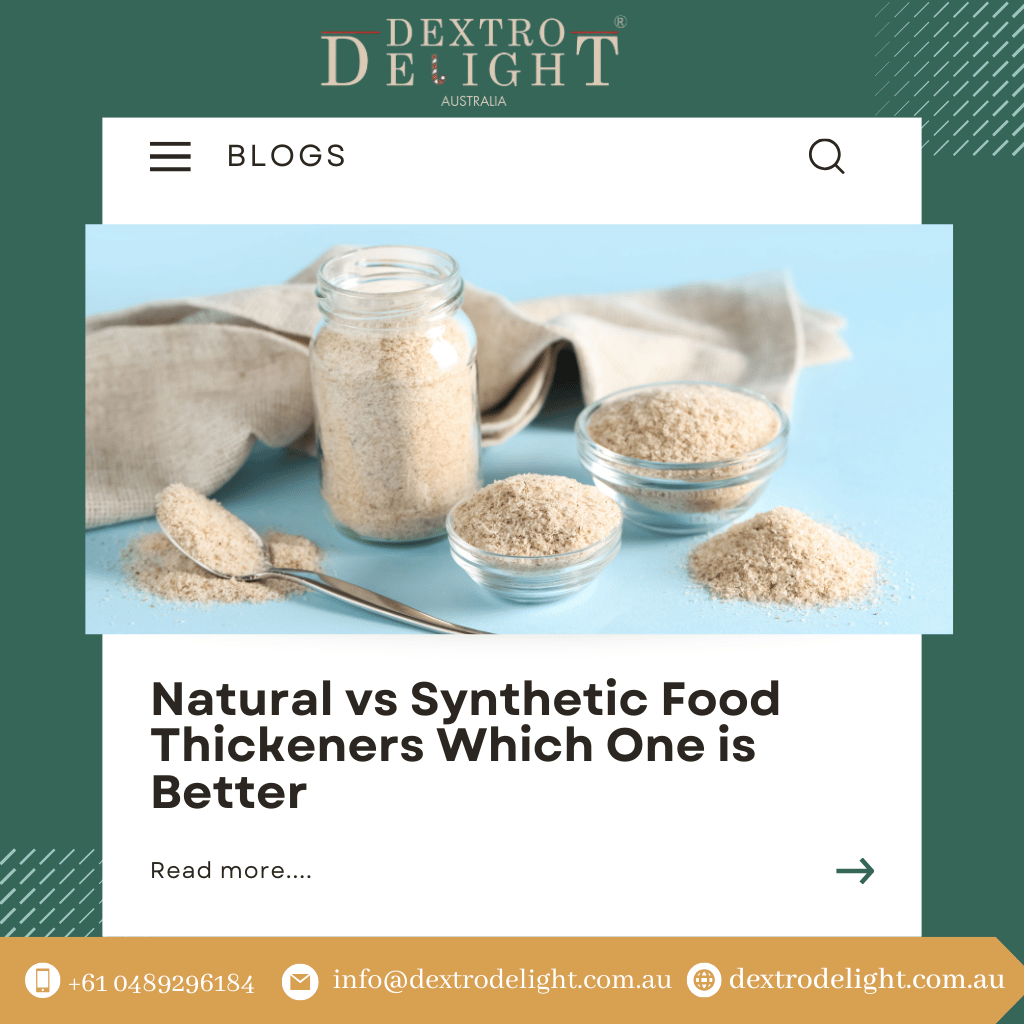
Functionality and transparency have become the vital criteria in the Australian food Industry. In the scenario where consumers are asking for healthier and cleaner ingredient lists with smoother textures, the food partners are reconsidering the use of thickening agents in their product formulations.
When it comes to sauces, soups, desserts, dressings, plant-based alternatives, or beverages, the use of the right thickener will have an impact on characteristics like texture, stability, mouthfeel, shelf-life, cost, and consumer perception.
There is an increasing interest in both natural and lab-created alternatives. But the question that each one asks is: Which is better? Natural or synthetic food thickeners?
This blog discusses the differences, performance capabilities, costs, clean-label influence, and industry applications. It will help you make informed decisions when dealing with food thickeners suppliers Australia-wide.
Understanding Food Thickeners
Food thickeners are used in the food industry as functional additives to enhance the viscosity, texture, and stability of formulations. They do not affect the other properties, such as taste, and the nutritional value remains the same. These food thickeners are used in the production of dairy, confectionery, beverages, gluten-free foods, and ready-to-eat meals.
Food thickeners are classified into two main categories:
Natural Thickeners – They are obtained from plants, animals, or microorganisms and are usually processed very minimally.
Synthetic or Chemically Modified Thickeners – These food thickeners have been obtained or altered through chemical processes under strict control to improve their functionality, reliability, and durability.
Natural Food Thickeners
Common natural thickeners include:
|
Thickener |
Source |
|---|---|
|
Xanthan Gum |
Fermented corn sugar |
|
Guar Gum |
Guar beans |
|
Agar Agar |
Seaweed |
|
Pectin |
Citrus fruits and apples |
|
Carrageenan |
Red seaweed |
|
Gelatin |
Collagen from animals |
Strengths:
- They are well-known and clean-label friendly
- Functionality often comes in different forms in the same product: gelling, stabilising, and thickening
- Vegan/organic/plant-based markets have been good (for example, agar, pectin, and guar gum)
Limitations:
- Variability in batches depends on the different quality of the crop and weather conditions
- Not that effective as larger amounts are needed in certain systems
- Changes in pH, heat and freeze-thaw cycles impact performance
- In some cases (e.g. agar, pectin), the cost is higher.
Synthetic and Modified Food Thickeners
The Synthetic food thickeners are processed to boost the viscosity, stability, and overall performance.
Common examples include:
|
Thickener |
Origin |
|---|---|
|
Modified starch (E1404, E1420) |
Plant-based starch chemically modified |
|
Carboxymethyl cellulose (CMC) |
Cellulose + acetic acid |
|
Polysorbates |
Lab-synthesised emulsifying thickeners |
|
Microcrystalline cellulose (MCC) |
Processed plant cellulose |
Strengths:
- High viscosity with low dosage
- Exceptional heat, pH and mechanical stability
- Good batch quality and uniformity
- Lower functional unit cost in bulk production
Limitations:
- Ingredient names are less consumer-friendly
- Might create disputes in clean-label or health-conscious markets
- No nutritional gain
Performance Comparison in Food Systems
|
Application |
Best Thickener Type |
Reason |
|---|---|---|
|
Ice cream |
Blend (natural + modified) |
Prevents ice crystal formation, smooth mouthfeel |
|
Gluten-free bakery |
Xanthan + guar |
Improves structure, elasticity, and moisture retention |
|
Soups and gravies |
Modified starch |
Consistency under high temperature and shear |
|
Vegan desserts |
Agar, carrageenan |
Gelling, firmness, and clean-label acceptance |
|
Beverages (plant-based milk) |
CMC or pectin |
Suspension, mouthfeel improvement |
Solution: Formulators regularly mix natural and synthetic thickeners to strike a balance between the three aspects: cost, functionality, and label expectations.
Factors to Consider When Choosing
Before partnering with Food Thickeners Suppliers Australia, evaluate the following:
|
Criteria |
Natural Thickeners |
Synthetic Thickeners |
|---|---|---|
|
Clean Label |
High |
Low |
|
Cost Efficiency |
Moderate |
High |
|
Stability in Heat/Shear |
Moderate |
Excellent |
|
Allergen Risks |
Soy, nut, animal |
Low |
|
Consumer Perception |
Strong positive |
Mixed |
|
Shelf-life Performance |
Moderate |
Excellent |
Final Verdict: Which One is Better?
There is not a single decisive answer.
Natural thickeners are the best in clean-label, organic, vegan, or health-focused applications.
Synthetic thickeners are the best in high-volume, heat-processed, cost-sensitive, and highly stable formulations.
A lot of manufacturers these days choose hybrid blends. They combine the stability of synthetic thickeners with the label appeal of natural ones.
Conclusion
Whether you choose natural thickeners or synthetic ones, your decision should depend on the product’s objectives, processing conditions, the consumers’ expectations and the budget. A strategic mixture may provide you with the best of two worlds – functioning and attracting the market.
If you’re searching for high-performance texturisers and thickener blends for your formulations, DextroDelight gives you the best guidance. We provide both natural and synthetic solutions along with technical support and formulations.
Connect with the best food thickeners suppliers Australia and explore a variety of food thickeners on our website.
Related Posts
How to Effectively Store and Preserve Your Ingredients to Ensure Freshness
Xanthan Gum Uses in Gluten-Free & Vegan Food Manufacturing